How do I make a mind map from a YouTube video?
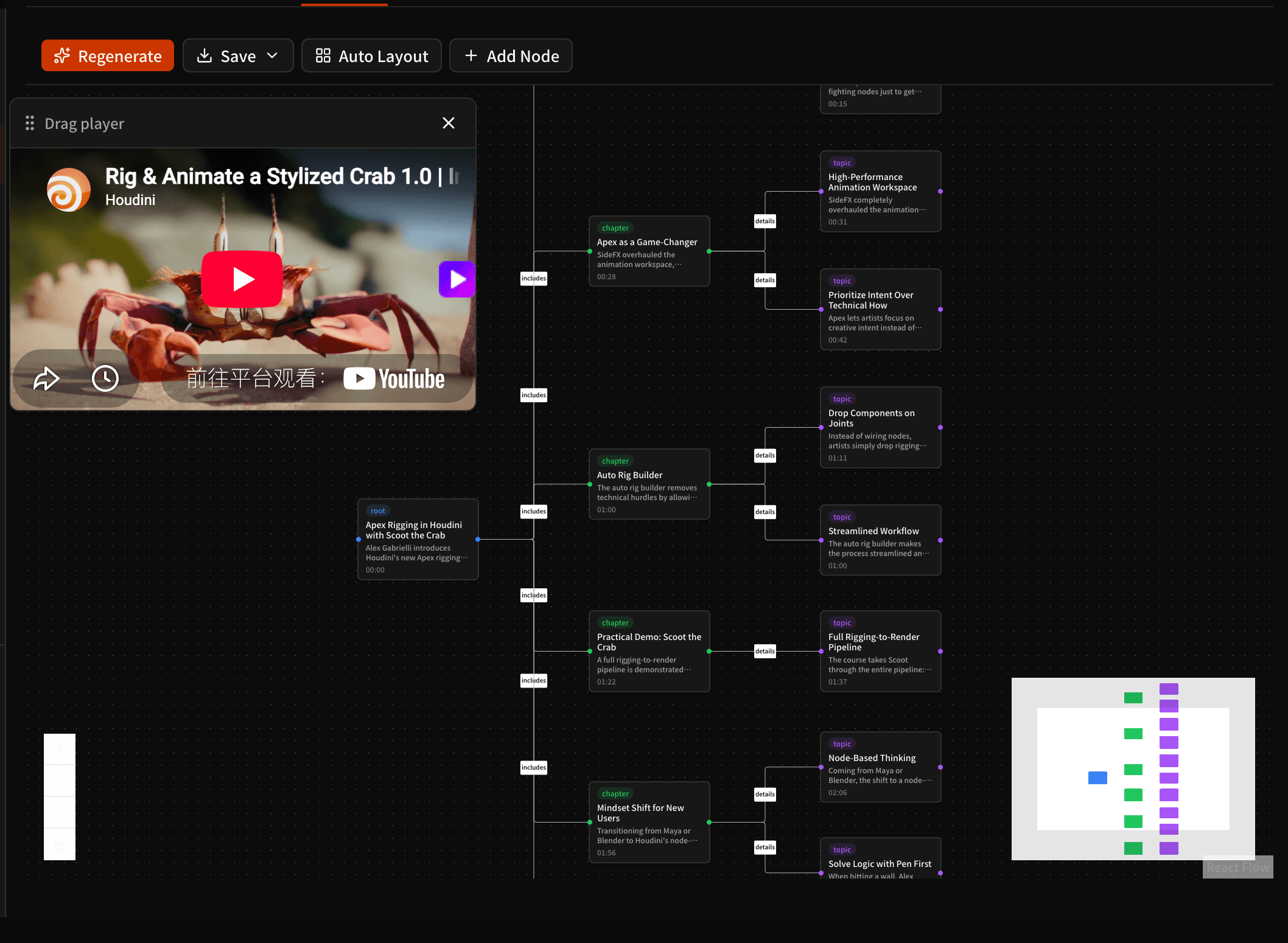
Paste a supported YouTube URL into TubeTutor and confirm the preflight analysis. The project processes the available transcript or required AI transcription, then the Mindmap module extracts the central topic, major branches, and supporting details into connected nodes. Open the Mindmap tab to review the result, follow timestamp references, and refine the structure in the editor.
Can AI create a mind map from a video?
Yes. AI can use a video transcript and its chapter context to identify major concepts and organize them into a hierarchy. The result is a starting model rather than unquestionable source evidence. TubeTutor keeps the map in the same project as the video and transcript so you can check the relationships, correct labels, and add details that the automated structure missed.
Is there a free AI mind map generator?
Mindmap is not included in the signed-out guest preview. Register or sign in to generate, edit, save, and export a Mindmap with a private project. New accounts receive 200 starter credits once, valid for 30 days, and generation follows the active credit price.
Can I edit an AI-generated mind map?
Yes. TubeTutor’s editor lets you rename nodes, add child nodes, delete unwanted nodes, change node colors or styles, and apply automatic layout after restructuring the map. That makes the generated result a working visual document you can adapt to your own terminology, study plan, research framework, or project structure.
Can I export a mind map as PDF?
The Mindmap editor directly saves the visual map as vector SVG or high-resolution PNG. Eligible Pro users can also export a broader study pack as PDF, and that document includes the current mind map alongside the project summary and other study content. TubeTutor does not label the PDF option as a standalone mind-map-only export.
Does the YouTube mind map include timestamps?
Generated nodes can include timestamp references that connect important concepts back to the source video. Use those references to revisit the relevant moment, hear the surrounding explanation, and verify how a visual branch relates to the original material. Timestamp coverage depends on the generated map and source transcript rather than appearing on every node.
Do mind maps help with studying?
Mind maps can make a complex topic easier to review by showing hierarchy and relationships in one visual space. They are especially useful for active study when you edit labels, reorganize branches, recall what belongs under each concept, and return to the source for evidence. A generated map works best as a starting structure that you actively refine.
What's the difference between a summary and a mind map?
A summary explains the main ideas in a linear reading order, while a mind map emphasizes hierarchy and connections between concepts. Use the map when spatial relationships help you think, or open the YouTube Video Summarizer when you want a concise narrative overview and key takeaways you can read from start to finish.